
Learning a language can be tough, whether it be your second or third and in my case filth! With a full time job, two kids, and a husband to look after I though the possibilities of learning a language was remote. Only when my two year old was watching Ni-Hao Kai-lan on the television was it possible to engage her and my husband in another language. So when this book review opportunity came I really wanted to give it a shot.
Having the sayings from Kai-lan, the small amount of Chinese food words and random words I picked up from my husband, I was totally lost and overwhelmed to start learning one of the oldest languages in the world.
 |
| Taken from Amazon.com |
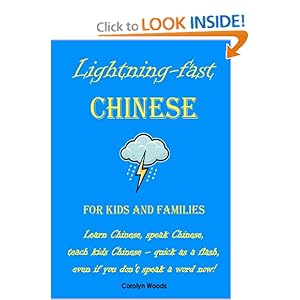
The book Lighting-Fast Chinese for Kids and Families by Carolyn Woods makes it easy. She creates prompts and guides in the 60 pages (in paper back or on the Kindle) that made it easy for me to ask my two year old basic questions in real life situations like getting dressed, going to the Zoo, and going to the store. How easy is that? Immersion is one of the best ways to learn a new language and by taking this book with us as we went walking to see the shī zi (lions), lǎo hǔ (tigers) and the xióng (bears) at the Zoo made it more interesting because we were having fun learning Chinese. And that is when real learning takes place.
A small video I made to show you how fun and easy the lesson are!
Lightning-fast Spanish For Kids and Families
Lightning-fast Spanish Vocabulary Building Crossword Puzzles
Lightning-fast Spanish Vocabulary Building Crossword Puzzles
Lightning-fast French For Kids and Families
Lightning-fast German For Kids and Families
Lightning-fast Italian For Kids and Families
Make Money From Home With A Children’s eBay Business
And just published
Lightning-fast Japanese For Kids and Families
There are only 2 cons I could see about the book. One was the lack of clarity of what dialect I was about to learn. In China there are two main branches Mandarin and Cantonese, then there are the smaller regional subsets. I had to ask my husband, who has a few years of the language, tell me it was Mandarin. The second was the word Pinyin, not until the end of the book is it defined, in the book, {as} the Chinese phonetic language, rather than characters. I would have liked to see that in the beginning as I thought it was the actual dialect of Chinese!
I give this book 4 out of 5 stars (Amazon Rating system), because of the ease of use that my family enjoyed learning from the book, but lost a star because of the confusion of the dialect and definition as I pointed out above.
